

 O Zavodu
 Sladkovodno ribištvo
 Strokovna mnenja
 Morsko ribištvo
 Ribogojstvo
 Novice ZZRS
 Ceniki
 Projekti v sladkovodnem ribištvu
 Poročila
 Tujerodne vrste
When fishing for huchen on a catch-and-release basis, proper handling of the fish is essential to reduce stress and the risk of injury and to ensure that the fish can be returned to its habitat as safely as possible.
The Fisheries Research Institute of Slovenia therefore recommends that anglers prepare properly before fishing and carry out unhooking, measuring and photographing as quickly as possible and, whenever possible, directly in the water.
Preparation and suitable equipment
Anglers are advised to wear high fishing boots, as these allow safe entry into the water and make it easier to unhook and release the fish directly in the river.
Use barbless hooks and a sufficiently large landing net with a soft, rubberised, knotless mesh. This type of equipment allows safer unhooking and reduces the risk of injury to the fish.
Keep the fish in the water for as long as possible
- After being caught, the huchen should remain in the water for as long as possible.
- Whenever possible, the entire process of unhooking, measuring and photographing should be carried out directly in the water.
- Do not place the fish on dry surfaces such as rocks, sand, grass or snow. Also avoid unnecessarily lifting the entire fish out of the water.
- During handling, it is recommended that the fish is not lifted out of the water by more than one third of its body height.
- Before touching the fish, wet your hands thoroughly, as this reduces the risk of damaging the protective mucus layer on its body.
How to measure a huchen correctly
The fish is best measured directly in the water using a purpose-made soft or foldable fishing measuring tape or measuring mat. Support the fish gently while measuring and complete the procedure without unnecessary delay.
Length is measured from the mouth to the end of the caudal fin.
As part of the ZZRS group fishing events, anglers will also receive special huchen measuring mats, allowing the length of caught fish to be recorded quickly and consistently.
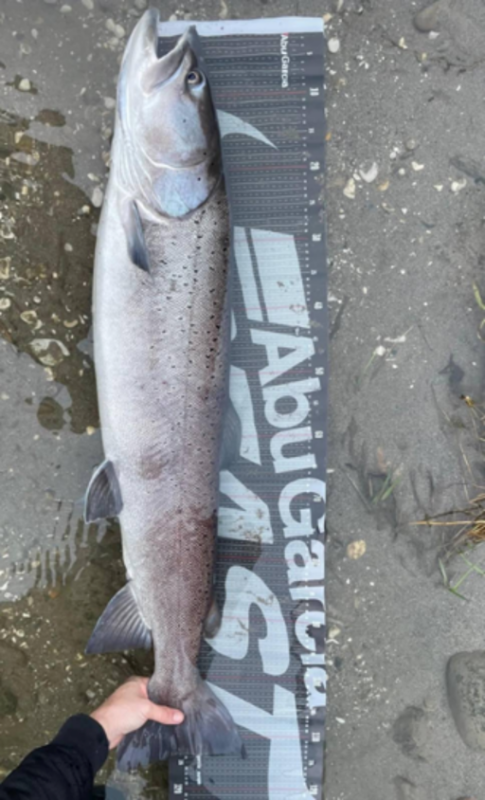
Example of correct huchen measurement.
Keep photography brief
Photography should be carried out as quickly as possible and without unnecessary delay. Have everything ready for the photograph in advance so that the handling time is kept as short as possible.
While being photographed, the huchen should be properly supported under the head and belly at all times. Whenever possible, the angler should keep both hands in the water and the fish should remain as submerged as possible.
After taking the photograph, release the fish safely as soon as possible.
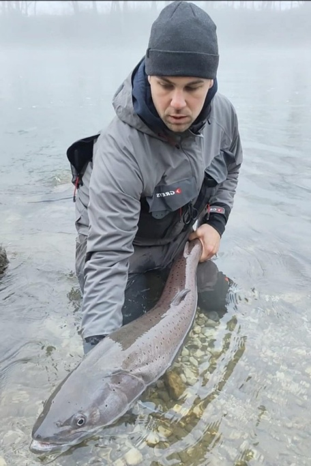
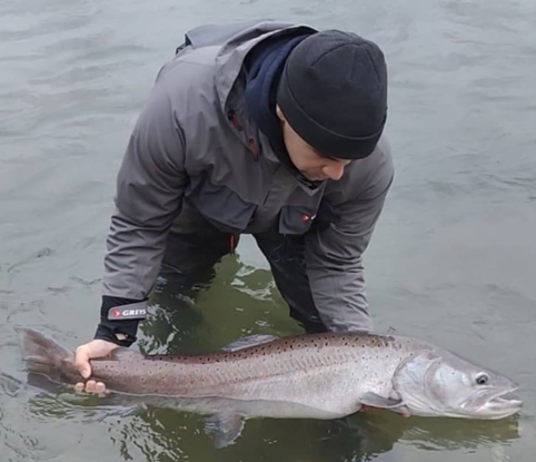
When photographing the fish, it should be properly supported and the time spent out of the water should be kept as short as possible.
What should you do if you catch a tagged huchen?
If a caught huchen has a tag, information about the catch is particularly important to the Fisheries Research Institute of Slovenia.
Record:
- the tag number,
- the exact catch location or GPS coordinates,
- the length of the fish,
- and take a photograph of the fish.
Submit the information to ZZRS via the online form: https://zzrs.si/ribolov-sulca/
You can also access the online form by scanning the QR code below.

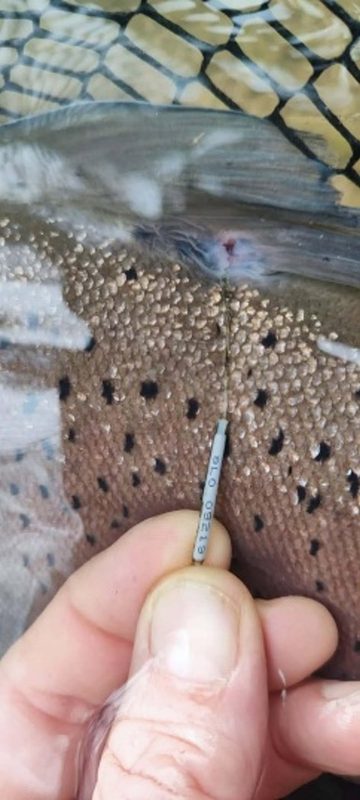
Example of a tagged huchen.
Data on recaptures allow experts to monitor individual fish over a longer period of time. The tag makes it possible to link information on the location and time at which the fish was tagged or stocked with its subsequent recapture and to monitor its growth and movements.
Every piece of information counts
Anglers play an important role in monitoring the huchen population. A properly recorded catch – even when the fish is immediately returned to the watercourse – can provide data that cannot be obtained through conventional sampling methods.
Proper handling also ensures that this information can be collected with as little impact on the fish itself as possible.
More about the new huchen fishing regime in the Sava 11 fishing district for the 2026/2027 season: https://zzrs.si/2026/09/25/huchen-sava-new-fishing-regime-population-protection/
Pingback: Huchen on the Sava: new fishing regime and additional measures to protect the population - Zavod za ribištvo Slovenije